Core Taekwondo: Attention, Bow, Ready, Begin
At Core Taekwondo, a family builds discipline, confidence, and joy (sometimes all at once).
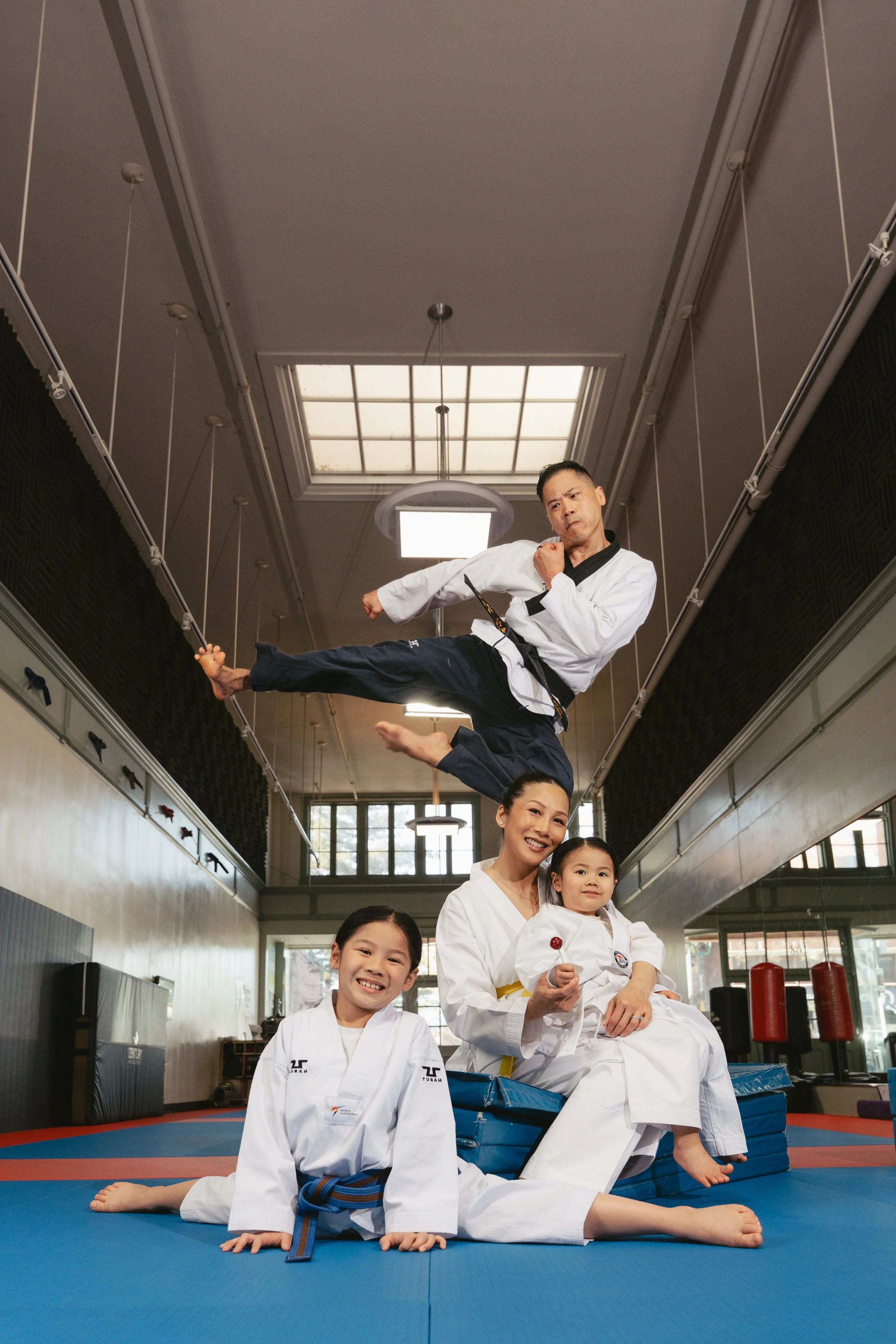
At Core Taekwondo, the body learns before the mind can explain.
A child plants her feet, squares her shoulders, bows. She is told where to look, how to stand, when to breathe, when to wait. A kick is broken into parts. A form is learned one sequence at a time. Balance comes before power. Repetition comes before ease. Confidence, if it comes at all, comes later—after the body has practiced believing it can.
This is one of the quiet truths at the center of taekwondo, and also, perhaps, of family life: you do not become strong all at once. You become strong by returning.
For Master Bryn Nguyen, that lesson began in childhood, under far less gentle circumstances. Growing up in San Francisco in the 1980s and 1990s, moving often and sometimes through rough neighborhoods, he came to martial arts for a reason both simple and painful: he was getting bullied. Bruce Lee offered the first image of possibility—a small man with command, speed, and self-possession. Bryn tried training young, found it did not instantly solve anything, and kept going anyway. Over time, the dojang became the place where fear was metabolized into discipline. It became a place to stay out of trouble, to get stronger, to keep coming back until the body knew something the frightened child did not yet know.
That memory still animates the work he does now
Before Core Taekwondo, Bryn and his wife Anita were living a different kind of ambitious life. He had fallen into radio and broadcasting, building a career that carried its own version of excitement—concerts, events, long hours, public energy. Anita was working in luxury retail, in the kind of polished, demanding environment she had once wanted very much to be in. They had children. They had careers. They had, in the broadest sense, made it.
But their days were arranged around absence.
His hours and hers pulled in opposite directions. Family life had to be threaded through schedules that were not built with family in mind. Then came the sort of moment that, later, can look almost choreographed by fate. At an Easter egg hunt, Bryn ran into an old friend from his martial arts life. His friend mentioned trying to open a school. Almost immediately afterward, an established taekwondo school in San Mateo appeared as an opportunity.
Bryn was not hunting for a business. He was, if anything, looking for a way back to training, back to his body, back to something that felt essential and perhaps neglected. But opportunities, like openings in a sparring match, do not always announce themselves twice. He looked into it. Then he brought Anita in.
That, in some ways, was the real test.
If they did this, Anita would leave the job she had built. Bryn would shoulder the strain of two worlds at once, at least for a while. Their family would have to be reorganized not around security, exactly, but around conviction. And Anita, by Bryn’s own cheerful admission, is usually the one with enough foresight to ask whether a leap is really worth taking.
This time, she saw that it was.
If Bryn is the outward force of Core—the teacher on the mat, the motivator, the one who can speak a room into coherence—Anita is its structure. Not in the abstract, but in the daily, indispensable ways that make a business real. The books. The systems. The planning. The calculations. The details behind the details. Bryn jokes that he would just be a guy doing martial arts if left to his own devices. Anita, he says, is the one who makes sense of things.
Together, they operate with something close to the logic of a good martial arts form: distinct roles, practiced timing, no wasted motion.
They never had to overdefine it. They knew. He would be the voice, the teacher, the public-facing energy. She would hold the internal order. He would work the floor; she would help make sure the ground beneath it stayed level. In taekwondo, one learns quickly that power without control is useless, and movement without balance eventually collapses. A school, it turns out, is not so different.
What Anita gained in the transition was not just a new role in the business, but a new relationship to time. The earlier job had offered prestige and polish, but less room for the life she wanted to live with her children. At Core, she found more flexibility, more presence, more access to the everyday rituals that make up a family’s actual memory: school volunteering, parties, vacations, the simple privilege of being there. She is not sentimental about the tradeoff so much as clear-eyed. This life fits better.
That fit, however, did not arrive fully formed.
Core Taekwondo was already a family-run school when Bryn and Anita took it over. There was history in the room, and a community attached to that history. The challenge was not simply to run the business, but to inherit trust. Could this new family step into an existing school without breaking what people loved about it? Could Bryn, with his different energy and style, retain students and reassure parents? Could Anita help build continuity while everything else was shifting?
In martial arts terms, this was not unlike stepping into a form mid-sequence: you have to understand where the motion began before you can carry it forward.
They did carry it forward, though not by imitation. Bryn brought his own energy, his own warmth, his own way of teaching. Anita brought her own intentionality, her own eye, her own way of shaping the environment around the training itself. Over time, the school became distinctly theirs without feeling severed from what came before. That is its own kind of mastery.
And what they seem to have built, over the years, is not just a school but a place of return.
Children come for many reasons. Some need confidence. Some need focus. Some need to be challenged. Some need a place to put their energy that does not ask them to become smaller in order to be manageable. Bryn knows this because he has met many versions of the child he once was. Not every student needs the same thing. Some arrive shy and need to be drawn outward. Others come in strong and need help with discipline, patience, or form.
Taekwondo offers no shortcut around any of that. It is, at heart, a practice of alignment: body, mind, attention, intention. You bow because respect must be rehearsed. You repeat a movement because competence is built, not bestowed. You learn to fight, yes—but first you learn to stand. To wait. To recover your balance after falling out of it.
Bryn teaches with that in mind. He wants students to have fun. He wants them to come back. He wants them to experience the satisfaction of growth without being crushed by pressure. He talks, at times, about “tricking” kids into learning—wrapping discipline in play, turning sparring into something close to tag before it becomes something more technical. But beneath the humor is a serious philosophy: if a child leaves feeling more capable than when they arrived, something important has happened.
That includes his own daughters, among them Cameron, who is already training and competing. But Bryn is careful here. He is a father before he is a visionary about legacy. He can imagine one of his girls taking over the school someday. He can imagine a beloved student doing it. He can imagine the next generation looking nothing like the one he can currently picture. What matters more is not whether his children inherit the business, but whether they inherit the deeper thing beneath it: a way of meeting life.
Do the hard thing. Keep your word. Return to practice. Trust that repetition changes you.
In that sense, Core is already generational—not only because children train here, but because whole families do. Parents join after years of watching from the sidelines. Siblings come in behind siblings. Children grow up, then return as instructors, mentors, examples to those coming after them. What is being handed down is not just a skill set. It is a culture.
San Mateo, meanwhile, has become its own part of the story.
Bryn came from San Francisco with the mild skepticism of someone who thought he knew what suburban life meant. Instead, he found a downtown with unusual vitality, a civic culture dense with participation, and a community willing to show up—not just for businesses, but for one another. Anita, too, seems to have recognized that Core could not simply exist in San Mateo; it had to become woven into it. School events, local booths, block parties, family relationships, parent networks: the school is part of the city’s everyday fabric now.
It is, in other words, both a business and a civic space.
That may be why the word that hovers over Core is belonging. Not in a sentimental sense, but in a practical one. People come here and become part of something. The mats offer structure. The instructors offer guidance. The families offer continuity. The children offer energy and proof. And Bryn and Anita, in their different ways, keep holding the container.
A family business, at its best, does not simply sell a service. It creates a way of life sturdy enough that others want to step inside it.
At Core Taekwondo, Bryn and Anita have built that life through a thousand repeated acts: opening the doors, teaching the class, balancing the books, encouraging the hesitant child, steadying the overconfident one, making room for the parents, trusting the slow accumulation of practice. In martial arts, there is no glory without discipline, no progress without form, no strength without returning to the work again and again.
The same is true of a family. Of a business. Of a life.
In the end, it all comes down to what you return to, and what you hold steady at the core.