Romolo’s Cannoli: The Luck of It
At Romolo’s, Joe Capello has inherited more than a cannoli and spumoni shop. He has inherited a temperament: make something worth coming back for, expect very little, do your best anyway.
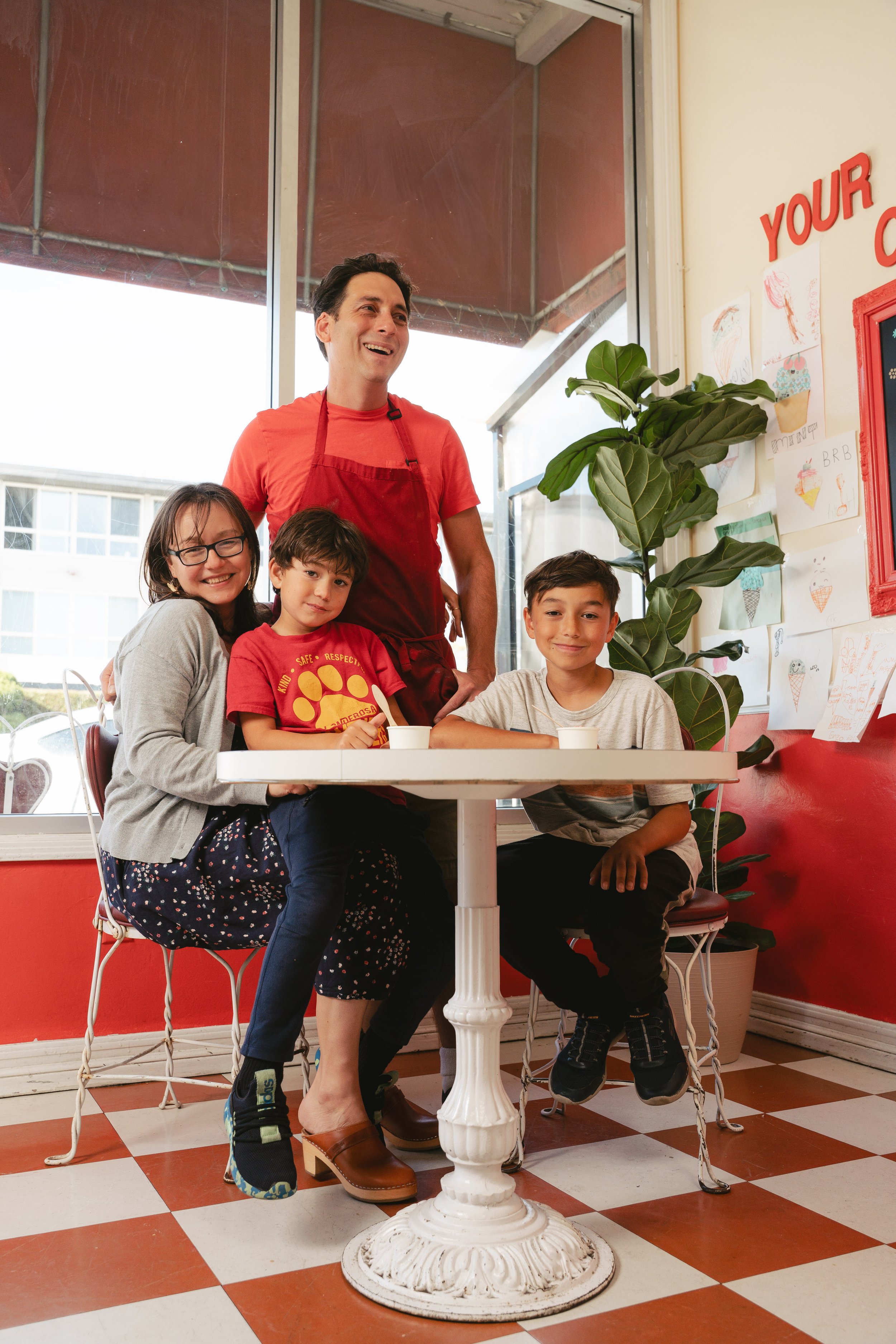
If you ask Joe how he came to run one of the Bay Area’s most beloved cannoli institutions, he will not give you the kind of origin story that flatters anyone.
He will tell you, instead, that he was the only one stupid enough to do it.
This is not false modesty, exactly. It is more like Joe’s preferred operating system: understate, deflect, make the joke first, then let the truth catch up on its own time. In his telling, Romolo’s did not pass gracefully from one generation to the next like a cherished heirloom. It sort of lurched. It survived. It landed in the hands of the available person under sufficiently guilt-inducing circumstances.
Which is to say: a family business.
Long before Joe was old enough to feel cornered by destiny, the business began as something else entirely. In the 1960s, his grandparents, Romolo and Angela, bought a Swensen’s ice cream franchise in San Mateo at the urging of Joe’s father, who knew, apparently before anyone else did, that his parents were not built for working under someone else’s rules. Soon enough, his grandparents started making cannoli under the banner of a very American ice cream chain, which did not go over especially well with Mr. Swensen. He called to inform them that franchises were not meant to operate like this. Joe’s grandmother, by family legend, more or less told him to get lost.
So the name changed. The cannoli stayed. Spumoni followed. There is, apparently, a Romolo’s way of making the spumoni. Joe explained it once, in a tone that suggested it was not knowledge meant to travel.
The business moved from Norfolk and Hillsdale to its current location on 37th Avenue in the early 1970s. The family bought the real estate. The place became permanent in the way small family businesses sometimes do: not because anyone sat down and mapped out a five-generation plan, but because someone made one stubborn, useful decision after another and, over time, those decisions began to resemble legacy.
Joe’s family had already crossed a few continents by then.
His grandparents immigrated from Sicily in 1958, after the kind of war-disrupted life that makes present-day complaints feel, in retrospect, a little soft. They had evacuated Sicily twice during World War II, leaving everything behind. There were spells in Africa, in Lebanon, in places that sound, in family memory, both specific and dreamlike. Joe describes his grandmother as having something like “gypsy magic,” half-joking, half-not. By the time they came to America, they had had enough of losing everything.
They landed first in Denver, sponsored by family. Four years later they moved to the Bay Area, where Joe’s grandfather worked as a baker in San Francisco and his grandmother as a seamstress. They saved their money. They built toward ownership. They were, Joe says, not people who liked being told what to do.
That trait appears to have held.
Joe himself grew up partly around the business and partly away from it. Summers here. Much of his upbringing in San Diego. He remembers the sensory world of it more than any single sentimental tableau: cocoa powder, cinnamon, vanilla, citrus. Almond paste good enough to make you reckless. Bubble gum ice cream and the dangerous discovery that the gum hidden inside it was available in bulk if you knew where to look. He remembers the flavors less as quaint family artifacts than as a kind of atmospheric constant, the air he was breathing before he knew it was distinctive.
He did not, however, grow up assuming he would one day be standing behind the cannoli counter.
By temperament and training, Joe might easily have wound up somewhere more sterile. He studied science and engineering. Worked in labs. Considered medicine. But the environments that rewarded precision without warmth never quite fit. He can do meticulous—his entire business depends on it—but he seems to need that meticulousness tethered to texture, smell, people, a certain amount of daily improvisation. A hospital felt wrong. A lab felt too slow. Results took years. Here, the feedback loop is more immediate: a shell shatters right or it doesn’t. A customer tastes something and is transported or they are not.
And then, in the early 2000s, the family business that had been drifting toward decline presented him with an unlovely but effective proposition: take it over, or live forever under a cloud of Italian guilt.
He took it over.
And then, in one of the least ego-driven business moves imaginable, changed almost nothing.
This is both joke and principle. Joe has improved processes, tightened ingredients, learned the craft to a granular degree. But he has not reinvented the place in his image, or tried to modernize away its oddness. The old register remained. The antique systems remained. The website, until very recently, was so poor at announcing the shop’s existence that Joe half-accepts obscurity as part of the brand. Most people in San Mateo, he says, discover Romolo’s after about 32 years of living here, which he delivers less as a complaint than as a statistical fact of nature.
The people who do know it, though, know it intensely.
Joe describes cannoli customers as a cult, which sounds exaggerated until you hear how the shop operates in people’s lives. Families come back from Gilroy, Salinas, Tampa, wherever life has scattered them, and make Romolo’s part of the return trip. Women arrive with daughters and granddaughters because the product, Joe says, is “altruistic,” by which he means giftable, a vehicle for care. Italian families who moved south from San Francisco decades ago still circle back. People fly through the Bay Area and detour for cannoli. Customers wander into the back to find him, no permission asked, just to see if he is still there.
He usually is.
Part of what they are returning for is continuity, but not the museum version. Joe is not preserving a dead artifact under glass. He is engaged in something more active, more precarious, more like keeping an old pirate ship from taking on too much water. The chandeliers are old. The equipment is old. The systems are old. Christmas nearly breaks the operation every year, multiplying demand beyond what the place was built to handle. The family and staff get stressed, the phones explode, everyone swears they cannot possibly do it like this again, and then, somehow, they do.
Only now, finally, Joe is allowing some new scaffolding in. A better website. Online ordering. The possibility that customers might one day find the place without having to be personally evangelized into it by someone carrying a box of cannoli to a holiday gathering. This is modernization by necessity, not ideology. Joe still counts change back by hand the old-fashioned way, because it pleases the exact kind of person who notices such things and lights up when they realize someone still does.
That delight matters to him.
So does craft, though he talks about it in a way that makes it sound almost annoyingly humble. The cream is one thing; the shell is the real battleground. Dough, he explains, behaves like dough always has: sensitive to wind, time, moisture, tempo. The longer you work it, the more it degrades. The goal is not speed so much as steadiness. The first cannoli in a batch may be noticeably better than the last, and he knows that. He is in constant negotiation with air, dryness, timing, the little betrayals of matter. This is where Joe the scientist and Joe the reluctant heir become the same person. He may joke around, but he works with a watchmaker’s precision.
There is another inheritance here, too, one Joe names more directly than he seems to realize: proportion.
His family history is full of catastrophes large enough to make contemporary inconveniences look almost theatrical by comparison. A great-grandfather taken prisoner during war, escaping and walking barefoot back to Sicily over two years. Ancestors on his mother’s side surviving violence, migration, starting over as children. Joe does not bring these stories up to romanticize hardship. He brings them up because they give scale. Traffic on 101, taxes, children refusing mac and cheese—real, yes, but small in the scale of things. What he seems to have inherited, more than a fixed set of values, is a tolerance for difficulty and an allergy to self-pity.
Do your best. Expect luck to help, because you will need it. Hold on to what you can. Let go of what you can’t.
That may be the closest thing Joe has to a doctrine.
It also shapes how he thinks about generations. He does not speak about succession with the eager sentimentality of someone desperate to be remembered through bloodline. He is not grooming his children for takeover. He is, in fact, fairly sure the smart outcome is that they do something else. If one day one of them wants it, fine. If not, that too is part of the bargain. “The work of generations,” as he puts it, may involve learning to let go. Families build so the next generation can have more options, but if they have more options, they may not return to the thing that built those options in the first place. That is not necessarily failure. It is just time being time.
Still, for now, the shop remains what it has long been: a place where flavor carries memory across distance, where women from three generations walk in together, where old Bay Area Italians and non-Italians alike come looking for something that still tastes like somebody meant it. A place where a man who claims not to want too much attention nonetheless understands, down to the spice note, how to make people feel seen by what they’re handed over the counter.
Joe would probably resist any attempt to make this sound nobler than it is. He might tell you he is just trying to keep the ship from sinking. He might say luck did most of the work. He might point out that cannoli people are strange and should not be encouraged.
But places like this do not last 58 years on luck alone.
They last because somebody keeps showing up. Because somebody learns the shell. Because somebody knows when not to change a thing. Because somebody, despite all evidence to the contrary, decides it is worth holding together one more season.
And because, every so often, a family hands down not just a business, but a way of seeing:
life is fragile, people are weird, flavor matters, and you may as well do it right.
Romolo’s Cannoli and Spumoni
Address: 81 37th Ave, San Mateo, CA 94403
Phone: (650) 574-0625
Menu: romoloscannoli.com