Full Circle Barbershop: In Nice Form
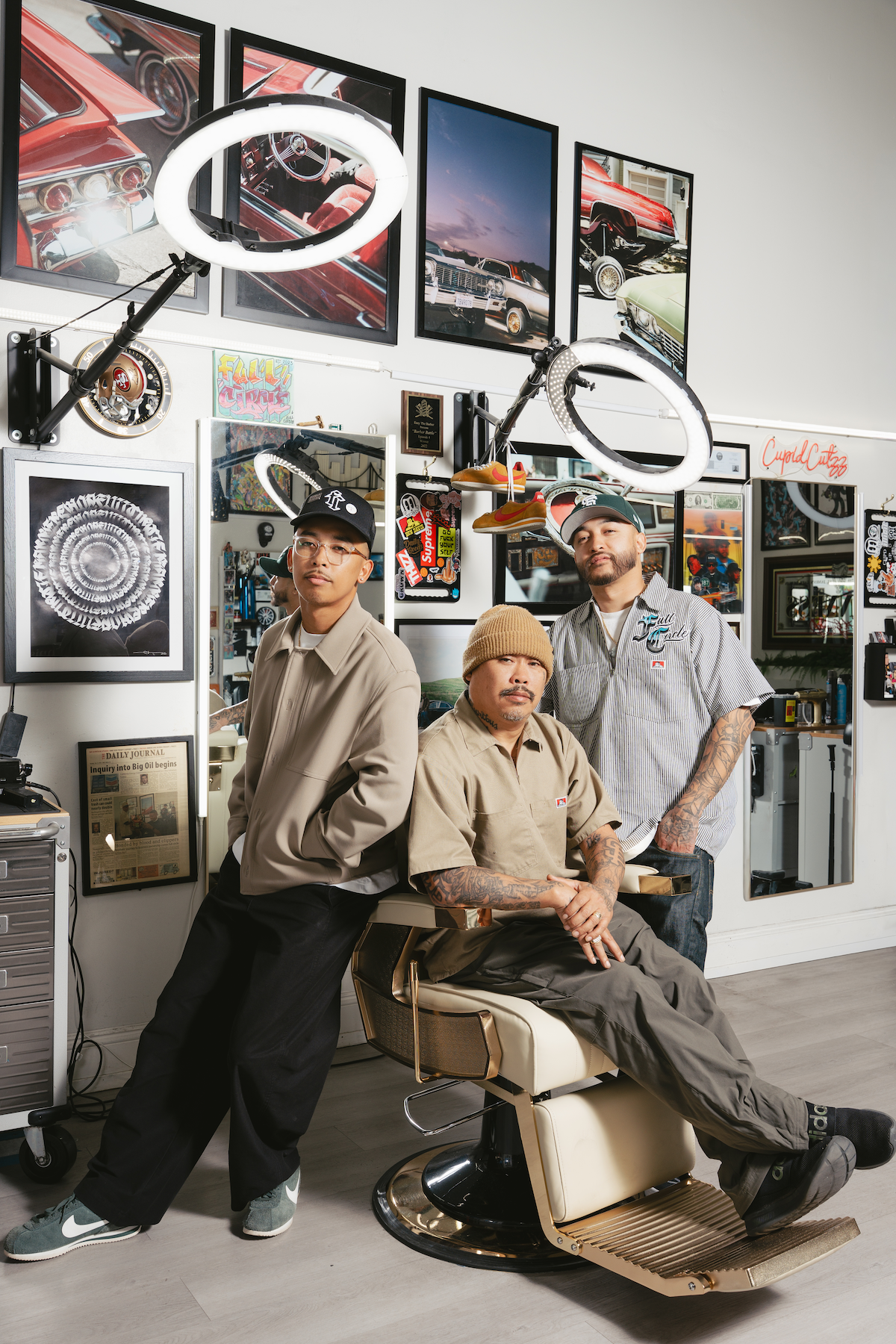
Codie Louie with his father and brother at Full Circle Barbershop on Baldwin Avenue
If you were to pass Codie Louie on the street, you might think you understood him.
The hat pulled low. The tattoos. The visual language of a certain kind of masculinity that signals hardness before anything else.
It would be easy to place him.
And it would be, almost entirely, incomplete.
You realize this when he looks up, breaks into an endearing smile, and is the first to say hello.
-
For as much as he turns heads when he walks around downtown San Mateo, Codie is the kind of person who notices you first.
Not in a way that draws attention to itself. There’s no performance in it. But there is a consistency. A habit of acknowledgment that feels increasingly rare.
He says that hello. He remembers your name. He steps out of his car to help someone cross the street. He buys greeting cards—not once, but often enough that it stops feeling like an occasion and starts to feel like a practice.
None of this is framed as virtue. He doesn’t narrate it that way.
It is simply how he has decided to move through the world.
-
But this is not where his story begins.
It begins, as many do, with imitation.
He and his brother, still young, still close enough in age to share both rivalry and allegiance, standing in front of a mirror, trying to fix something they didn’t like. Their father had been cutting their hair. They believed they could do better.
So they tried.
What started as lineups—small corrections, really—became full haircuts. First on each other, then on cousins, then on whoever was willing. By high school, Codie was cutting regularly. Not because he had chosen it, exactly, but because it kept choosing him.
It was a skill that lingered.
And for a while, it remained just that.
He moved through the expected phases—school, work, the low-level hum of trying to determine what, exactly, he was meant to do. The haircutting stayed in the background, useful but not yet central.
Then came a moment that would, in retrospect, feel almost too narratively convenient.
A funeral. His great-grandfather’s.
It was there that Codie learned something no one had made particularly explicit before: that his great-grandfather had been a barber. That there had once been a shop. That this wasn’t a new path at all, but a return.
“I didn’t know,” he says. “But it made sense.”
There is something about discovering lineage retroactively that can feel less like inheritance and more like alignment. As if the thing you have been circling has been circling you, too.
-
He enrolled in barber college.
From there, his life condensed into effort. Multiple jobs. Long days. Cutting hair at night in his parents’ garage, building a clientele slowly, one person at a time.
It is tempting to describe this period as hustle, but that word flattens something more specific.
What Codie was building wasn’t just a business.
It was a way of being with people.
Clients came back, not only because of the haircut—though the haircut mattered—but because of the experience of being remembered.
It is a subtle distinction, but an important one.
To be recognized in a place where you are not required to be known is a small, almost disarming pleasure. Codie offered that without ceremony. He didn’t brand it, didn’t systematize it. He simply practiced it, over and over, until it became the defining feature of his work.
A simple hello goes a long way, he says.
In his hands, it becomes infrastructure.
-
Clarissa noticed this before he did.
Where Codie moves instinctively—responsive, immediate, relational—Clarissa operates with a different kind of awareness. She watches. She tracks. She sees the throughline.
She saw not just that people liked him, but why.
That they felt accounted for.
That they returned, again and again, to the same chair not just for maintenance, but for something steadier.
Others can see that he shows up, but what Clarissa knows is that he shows up the same way. Consistently. Reliably. Without requiring recognition for it.
Which, in a business built on appearance, is its own kind of discipline.
-
The decision to open his own shop did not arrive as a single moment.
It accumulated.
A change in ownership at the shop where he had been working. A subtle shift in energy. The sense, difficult to articulate but hard to ignore, that it was time.
He began looking.
Then Baldwin Avenue appeared.
-
The space itself was unremarkable in the ways that matter to outsiders.
The lighting was off. The layout needed work. It had been a salon for decades, carrying with it the memory of other people’s decisions.
But Codie did what he always does.
He paid attention.
He walked the block. Felt it out. “My dad always told me, location is everything,” he says.
His father, an artist—graffiti, then tattooing—understood something about placement. About context. About how environment shapes perception.
Codie saw it here.
So he committed.
-
There is a story about how the lease came together, and it has the improbable neatness of something that sounds embellished but isn’t.
He gave a haircut to a kid, a new client. At the end, the kid mentioned that his parents were the landlords of the space Codie was trying to secure.
Within the hour, the lease was done.
Codie tells this story without emphasis, but it is no small thing. It wasn’t luck, exactly, because it was the outcome of something less visible: years of building trust in small, unrecorded ways.
-
The shop opened with his brother, Andrew.
Together, they represent a kind of internal balance.
Codie holds the front—conversation, flow, the constant recalibration of human energy. Looking out onto the horizon and ensuring the ship is locked in on the right coordinates.
Andrew is able to hold the structure—direct, steady, ensuring that the system underneath the atmosphere doesn’t collapse.
Clarissa moves between them, often unseen, often unspoken, but integral.
She holds a different kind of line. One that is less about the moment and more about the continuity of the thing itself. Codie’s partner and muse, she is almost the entire reason the shop exists.
-
Inside Full Circle, the atmosphere resists easy categorization.
There is music—funk, reggae, something with rhythm. There is laughter, often. Sometimes singing. Clients who arrive for a haircut and stay for something less defined.
There is, notably, a lack of friction.
This is not accidental. It is the result of a thousand small calibrations.
-
Codie’s nickname—Mr. Nice Form—captures something that is otherwise difficult to articulate.
Form, in this context, is not aesthetic alone.
It is behavioral. It is the repetition of the right thing, done cleanly, done consistently, done without deviation.
Haircuts, yes.
But also posture. Presence. The way he carries himself through interactions that most people would treat as incidental.
“It’s consistency,” a long time client says.
Which is another way of describing discipline without making it sound severe.
-
There is a particular kind of young man Codie represents, though he would likely resist the framing.
Filipino. First-generation in spirit, even if not formally so. Raised within a set of values that emphasize respect, presence, care for elders—values that are often named nostalgically, as if they belong to another era.
Codie does not describe himself this way.
He simply lives inside those values.
The question of the future—of what continues, what gets passed on—sits lightly with him. He does not speak in terms of legacy with any urgency. Instead, he speaks about the people immediately around him.
The younger barbers. The ones coming in, learning, watching.
“The seed is already planted,” he says. “You just have to water it.”
It is a statement that sounds simple, until you realize how much patience it requires.
San Mateo, around him, is changing.
More density. More movement. A downtown that is no longer quiet in the way it once was.
Codie does not resist this.
He adapts, as he has always done, by paying attention.
-
If you return to that first impression—the tattoos, the swagger, the visual shorthand—it remains intact.
But it is no longer sufficient.
Because what defines Codie is not how he appears at a glance.
It is what he repeats.
The door held open. The name remembered.
The greeting that lands, every time, the same way.
In a world that increasingly rewards speed and scale, he has chosen something slower. Something steadier. Something that, over time, begins to feel less like effort and more like instinct.
A form, practiced long enough, until it becomes who you are.
Which in Codie’s case, is really really nice.