Porterhouse: The Standard of Service
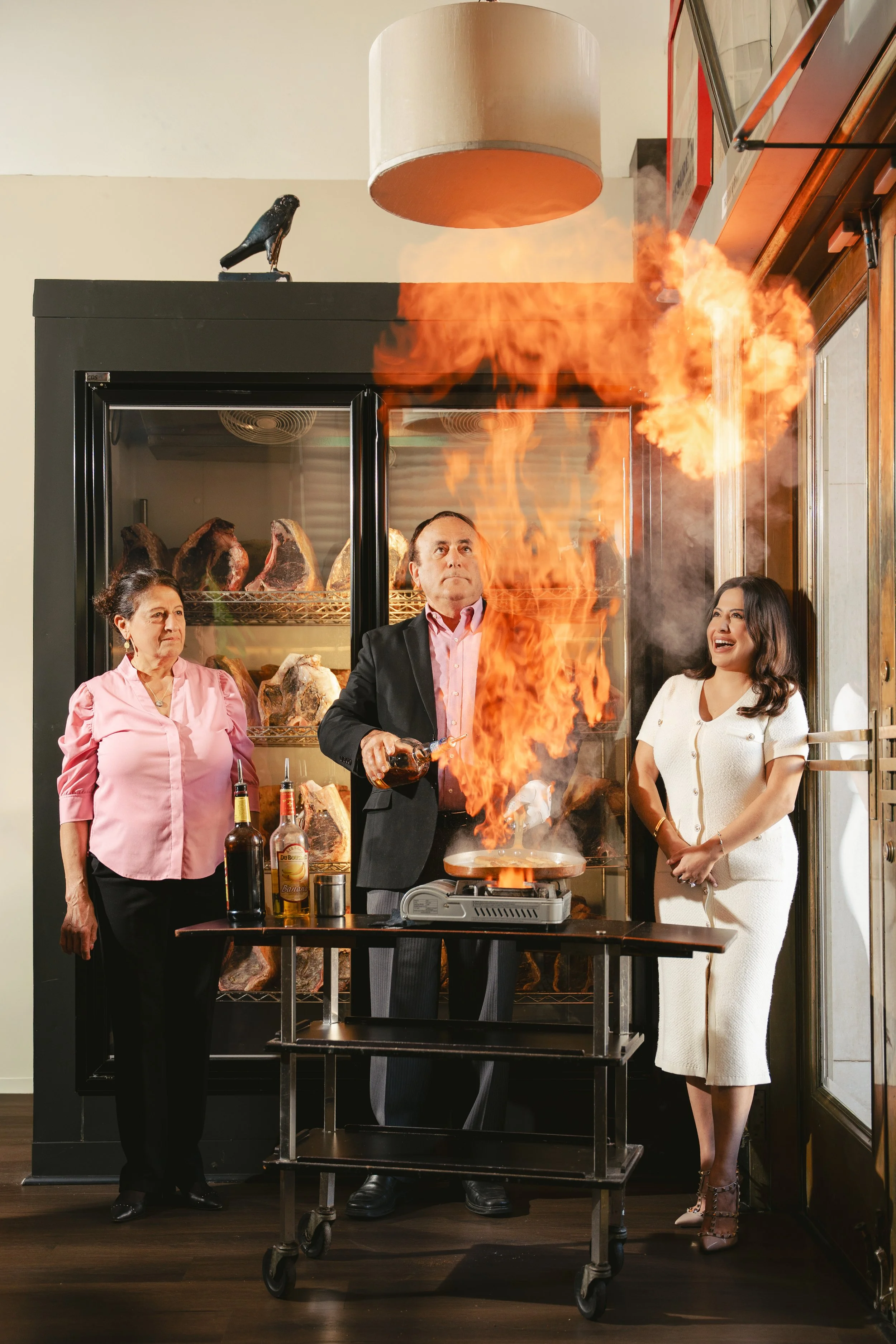
There is a way a room feels when someone is watching it closely.
At Porterhouse, that feeling starts before you sit down. It’s in the pacing, the light, the sense that nothing has been left to chance. And then, somewhere between the host stand and your table, you notice him, Bruno, already in motion.
He doesn’t hover. He doesn’t perform welcome in the obvious way. He adjusts. Straightens. Scans. A hand briefly on the back of a chair, a glance toward the kitchen, a quiet recalibration of something you wouldn’t have noticed unless it were off.
Ask his youngest daughter, Zelal, what defines him, and she’ll tell you something else.
“The toilet paper,” she says, laughing. “Even with that, he insists on the best.”
It sounds like a joke, and it is. But not entirely. In Bruno’s world, care is not reserved for the visible parts. It extends all the way down. That’s where the standard lives.
He came to San Mateo in 1982, by way of London, where he had taken his first job as a dishwasher. He was young and far from home, learning the rules of a new country through restaurant work—the pace of it, the hierarchy, the unspoken expectations.
For many Kurdish families, hospitality is not a profession. It is a form of dignity. You receive people well not because it is profitable, but because it reflects who you are. Guests are not transactions. They are a reflection of your honor.
It appears Bruno has carried that with him, whether he named it that way or not.
Five years later, with his wife pregnant, he bought Bogie’s, the French restaurant where he had been working. It was not a clean transition. There were reversals, moments where the deal nearly collapsed, stretches of uncertainty that he still recalls physically—sleepless, unsettled, unwilling to go backward.
But he moved forward.
And once it was his, he treated it that way.
At Bogie’s, and later at Porterhouse, Bruno became known less for a single thing than for a way of doing things.
He was there. Always there.
He knew the room. He knew the regulars. He knew when something was off before anyone said it. And when the desserts came out—Bananas Foster, Cherries Jubilee—the flames were not just spectacle. They were punctuation. A reminder that dinner could still be an event.
That kind of attention builds slowly. It also requires a particular kind of life.
Zelal grew up inside that life.
Born in 1994, the youngest of four, she doesn’t remember a version of family that didn’t include the restaurant. Birthdays, holidays, ordinary nights—most of them looped back to wherever her father was working.
“He never closed,” she says. “Ever.”
Christmas, Thanksgiving—it didn’t matter. Those were the busiest days. And so that was where the family went. Not because they had to, exactly, but because that was where everything converged.
Her father in motion. The staff moving around him. And her mother, nearby.
Not directing, not announcing herself—but present in a way that feels, over time, foundational.
Bruno’s jokes include her often. They land easily, part of the rhythm between them. She smiles, lets it pass, the kind of patience that comes from having lived alongside the same intensity for decades.
They’ve been married 53 years.
The restaurant sits inside that span, not the other way around.
Bruno did not set out to build a family business in the romantic sense. In fact, he warns against it.
“This job,” he says, in various ways, “is too hard.”
Too many hours. Too much responsibility. Too little margin for error. In his view, you don’t recommend this life to someone you love.
But he did bring his children into it—carefully, deliberately.
No one worked for free. If they showed up, they were paid. If they were given responsibility, it mattered. Discipline was not optional. Attention was not optional.
Zelal learned this in layers.
First as a hostess—learning how to greet, how to read people, how to hold her own with adults at an age when most kids are still unsure of themselves. Then later, on the back end of the business, where her father checked everything.
Invoices. Numbers. Small discrepancies.
At the time, it felt excessive. Now, she understands it as protection.
“You can go under fast,” she says. “If you’re not on top of it.”
San Mateo, meanwhile, was changing.
Bruno remembers a different downtown. A different B Street. Different customers. Different expectations. Over time, the city shifted—demographically, economically, culturally.
He adjusted.
In the early 1990s, he opened Spiedo, expanding his presence. In 2007, during a recession, he made a more visible move—transforming Bogie’s into Porterhouse, shifting the concept to meet a new moment.
He didn’t frame it as reinvention. Just necessity.
“People change,” he says. “Taste change. You change.”
There is no sentimentality in it. But there is also no surrender.
What he notices now is something else.
People come in, but they don’t stay the same way. They are faster. More distracted. On their phones. The meal is shorter. The attention thinner.
He remembers when people dressed for dinner. When they sat longer. When they treated the evening as something to enter into, not move through.
He doesn’t argue against the present. He simply refuses to lower his standard to meet it.
Zelal, now working full time at Porterhouse while running her own boutique, Honey and Hive, a few blocks away, occupies a different position in that shift.
She sees what convenience culture does to small businesses. The ease of ordering online. The willingness to trade quality for speed. The erosion of interaction.
And still, she stays.
When she trains staff, she keeps it simple.
“Treat every person like they’re coming into your home.”
Not the easiest. Not the highest spending. Everyone.
It is a principle that sounds soft, but requires precision.
What holds all of this together is not just work ethic.
It is a set of values that don’t always get named out loud.
Pride, without show.
Care, without shortcuts.
Responsibility that extends beyond yourself.
And, underneath it, something quieter: endurance.
The kind that shows up every day. The kind that allows someone like Bruno to build something over decades, and someone like his wife to stand beside it without needing to step forward to be essential to it.
A restaurant like Porterhouse is easy to read on the surface.
Steaks. Wine. Atmosphere.
But spend enough time there, and something else becomes visible.
A man who watches everything.
A daughter who has learned to do the same.
A woman who has held the center without needing to claim it.
And a way of life that insists, even now, that how you receive people still matters.
That the table is not just where you eat.
It is where you show who you are.
Porterhouse Restaurant
Address: 164 S B St, San Mateo, CA 94401
Phone: (650) 579-5911
Menu: porterhousesanmateo.com